Photography
- Recently Added
- Popularity
- Name
About 521 filtered results

Posted
Photographer Chrystofer Davis teaches the basics of documentary photography and how to tell a story through your pictures. Build your technical skills by learning about composition, lighting, and editing.
0:00 - Intro
1:16 - Why we preserve photos
6:56 - Finding your purpose
23:18 - Best practices
28:43 - To hunt or fish?
34:51 - Portrait & candid techniques
39:56 - Documenting in studio
46:27 - Studio photo demo
56:14 - Closing thoughts
Sponsored by

by Jill Waterman · Posted
There is perhaps no truer sign of summer than Independence Day in the United States. The Fourth of July is when the summer season kicks into full gear, with barbeques, pool parties, family gatherings, and road trips galore—not to mention the fireworks!
One lead-up to this holiday that I will never forget found me hurtling down the New Jersey Turnpike at sunset in a Greyhound bus. As the twilight deepened, bright bursts of fireworks began shooting up past the tree line, close by and at a distance, reflecting in the darkened glass of the

by Bjorn Petersen · Posted
When assembling a kit of lenses for photographing a wedding, one should take into consideration the location in which the wedding is taking place, the number of guests and, of course, the type of imagery you are seeking to create. To best represent a wedding in a dynamic manner, it is often preferable to have a range of lenses to achieve different perspectives of the event, rather than maintaining a constant perspective of your subject matter. A wide-angle lens, specifically, is a highly effective tool for capturing many of the scenes that

by Todd Vorenkamp · Posted
Many interchangeable-lens cameras, be it DSLR or mirrorless, are sold today with what we call "kit" lenses. Current kit lenses, in general, thanks to computer technology and advanced manufacturing techniques, are more capable and of higher quality than those of yesteryear. However, many of us who use interchangeable-lens cameras feel the gravitational pull of other lenses that are not yet in our bags.
Adding lenses to your quiver is all about choices and selection and, in photography, we often find ourselves at a sort of "gear crossroads." The

Posted
Photographer Sergio Meléndez has been staying true to his roots and following his passion for success. After over two decades as a photographer, Melendez has learned what it takes to stay motivated and how to adapt to the changes of the industry. He shares his experience and past images to show how he got his work in multiple exhibitions in New York.
0:00 Intro
1:20 Finding my vision
5:04 Documentary photography
12:06 The documentary process
24:42 Exhibiting in New York
27:53 Turning personal passion into meaningful projects
29:16 Discussion

by Luke Rollins · Posted
Macro photography never ceases to amaze me. Show me the face of a jumping spider reproduced at life-size or greater and I’ll undoubtedly stop what I’m doing and stare at it for a while. What’s interesting is how ultra-wide-angle lenses, which are available for DSLRs and
by Luke Rollins · Posted
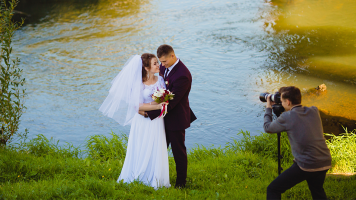
Many hobbyists reach a turning point in their craft when they decide to pursue wedding photography seriously. With the transition to pro comes the task of updating your lens kit accordingly, and most photographers would agree that investing in quality glass is essential. Unlike the rapid turnover of camera bodies, lenses will last for years and can make all the difference in creating quality images. Understanding what some of the best available options are will help you invest appropriately.
What to Consider
Weddings are long affairs, often

by Todd Vorenkamp · Posted
There are many ingredients in the recipe that make a good photographic portrait—foreground, background, setting, pose, expression, color, lighting, and so on—but one element that can be as important to the result as the portrait sitter is the lens used to capture the portrait and help create the art.
Technically, any lens can be used to take a portrait with your camera, and there are traditional focal lengths for “portrait lenses” like 85mm and 105mm, but I asked my fellow B&H photographers, as well as our B&H Creative partners and

by Mathew Malwitz · Posted
Wedding and portrait photographers looking for a lightweight, compact system with exceptional performance need look no further than the FUJIFILM X cameras and lenses. While the size and weight advantage of mirrorless cameras spans from Micro Four Thirds to full frame, the APS-C sensors in the FUJIFILM X system allow the cameras and lenses to be relatively small and light. Full-frame mirrorless is attractive to many, but the portability advantage of APS-C sized lenses is not to be understated.
For those looking to one-up the full-frame shooters

by Todd Vorenkamp · Posted
Close-up or macro photography is an incredible way to capture the tiny world around us on a super-detailed level. While the dedicated macro lens is still one of the best tools for exploring the world on a miniature scale, there are some very inexpensive ways to jump into macro photography with the lens or lenses you already own—no need for a specialized close-up macro lens. In this article, we will take a closer look (no

by Todd Vorenkamp · Posted
The Micro Four Thirds system is becoming popular among a passionate group of wedding photographers. The compact size of the cameras and lens system, as well as the sheer number of available lenses from, OM System, Panasonic, and other manufacturers, not to mention the nearly limitless option of adapted lenses, means that the wedding photographer has many options for capturing the action.
It’s worth noting that OM System, formerly known as Olympus, has lenses with both branding. As lenses are updated, they’ll adopt the OM system name, but as

by Josh Taylor · Posted
Many experienced photographers think of fast moderate telephoto lenses, as “portrait lenses” because so many professional portrait photographers rely on them. Lenses in the 85-105mm focal length range with maximum apertures between f/1.4 and f/2.8 can capture frame-filling headshots and head-and-shoulders portraits at moderate shooting distances, thus minimizing apparent perspective distortion—the dreaded “big-nose effect”—in close-ups. And they deliver very shallow depth of field at their widest apertures, creating compelling pictorial

by Mathew Malwitz · Posted
Lens selection is a highly personal choice for the professional photographer. Your shooting style, client needs, and cost all factor into how you choose to build your kit. Wedding photographers require a greater variety of lenses as they must cover a diverse assortment of compositions in various environments and lighting conditions. As working professionals, it’s only natural to begin investing in high-quality professional glass. For Canon users, this is the L series.
Easily identified by a thin red line circling the lens barrel, L glass is

by Bjorn Petersen · Posted
As a student, much of your life is about making choices and sacrifices. “Should I skip this class and sleep in?” or “Should I go to class even though I’m too tired to pay attention?” There are a lot of hard decisions to make as a student, especially if you’re a burgeoning photographer looking to attain professional status.
But, as a student, means are often limited and you need to be more conscious about what gear to add to your kit. What gear is critical and worth the investment versus what are some of the things you can ignore for now and

Posted
Photographers have a magical ability to transport us to hidden worlds, giving us intimate access to facets of society that would otherwise go unnoticed.
Above photograph © Marcela Taboada
In today’s podcast, we sit down with Mexican photographer Marcela Taboada, whose long-term documentary projects offer revealing glimpses into under-recognized communities, for Picturing World Cultures.
Combining a passion for making pictures that let her “see backstage,” with a knack for “knocking doors” and the tenacity to win over resistant subjects,