Film Cameras
0 Plays ·Posted
There is no doubt that a film photography renaissance is in full swing… just ask anyone under the age of 25. And to be fair, there are many wonderful artists—of all ages—who have never stopped using film as their primary photographic format. To anyone who grew up shooting film and then made the transition to digital, it’s a bit curious to see such a resurgence in a medium that has long been listed as “critical,” if not simply dead. At the B&H Photography Podcast, we still shoot
by Allan Weitz ·Posted
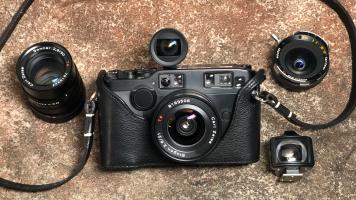
When the Contax G1 was introduced, in 1994, I was immediately smitten. Leicas were out of my price range and, despite the accuracy of Leica’s viewing and focusing, the thought of composing through a viewfinder and not seeing exactly what the lens was seeing made me queasy, especially when out on assignment.
The G1 was different. It was a rangefinder camera, but it offered the choice of manual focusing or autofocus. You also had the choice of Auto, Aperture priority, or Manual exposure control, and TTL flash. The G1’s viewfinder automatically

There is no doubt that a film photography renaissance is in full swing… just ask anyone under the age of 25. And to be fair, there are many wonderful artists—of all ages—who have never stopped using film as their primary photographic format. To anyone who grew up shooting film and then made the transition to digital, it’s a bit curious to see such a resurgence in a medium that has long been listed as “critical,” if not simply dead. At the B&H Photography Podcast, we still shoot

The new school year is nearly upon us, which means it’s time to start stocking up on necessary gear and supplies. For film and photo students, that means finding the camera and gear that’s right for you.
Generally, schools require a DSLR or mirrorless camera with detachable lenses and full manual controls. Far from the smartphone or point-and-shoot pocket camera many of us are used to. To help you get the perfect tool, we’ve put together a list of some of our favorite cameras broken down into four categories:
Best Overall Cameras
Best Mid

Opting for a used camera in excellent condition can be a great way of acquiring a high-quality, high-performance machine at a very attractive price. To give you a heads-up on some of the best deals out there we’ve carefully selected 10 cameras—five digital and five analog—that will give you a substantial bang for your buck and also fit seamlessly into your present system. There’s always an element of subjectivity in compiling an “A-list” like this, and there are certainly many other fine choices available in both categories.
Because digital

by Allan Weitz ·Posted
Some cameras challenge you every step of the way. The Fujifilm G617 is such a camera, but the results are worth it. First introduced in 1983, the G617 is a wide-field camera that captures photographs with 3:1 aspect ratios measuring 2.25 x 6.5" (6 x 17 cm). The G617 was designed for shooting landscapes, architecture, and—from personal experience—speedboat catalogs (more on this later).
The G617 is fully mechanical and fully manual—no batteries required. Ever. You compose pictures using the camera’s fixed optical finder, which isn’t coupled to
by Allan Weitz ·Posted
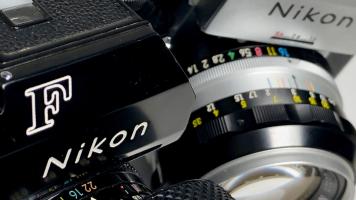
The Nikon F was introduced in 1959. Integrating a newly designed mirror box, pentaprism, and bayonet lens mount with existing components from Nikon’s popular SP rangefinder camera, Nikon’s engineers were able to design a pro-quality 35mm camera that could be used with lenses longer than 135mm without having to resort to a reflex housing, which has its own limitations. Nikon’s management and engineering team wanted a professional-quality reflex camera system that would surpass the limitations of rangefinder cameras and, hopefully, expand the
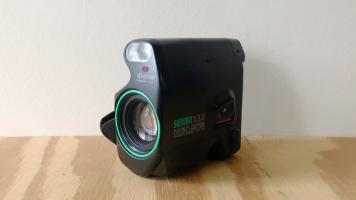
What looks like a camcorder from the 1980s, takes upwards of 75 shots per roll, and is really an SLR with a built-in 3x zoom lens? The answer: the Kyocera/Yashica Samurai X3.0. This uniquely little, albeit somewhat big, camera is a half-frame 35mm film camera, meaning that instead of taking 24 x 36mm images, it records 17 x 24mm images. And since these frames are half the size of a standard 35mm frame, you get twice as many frames per roll. Half-frame camera aside, what really drew me to this camera was how strange and distinctive it looks. It

by Rowynn Dumont ·Posted
The Graflex Speed Graphic, to the touch, is boxy, with a leather side strap for a sturdy on-the-go grip, denoted for its press-style aesthetic. Only those considered truly serious photojournalists from the 1900s-1950s used the Graflex. The camera’s most renowned debut was when Weegee, the newspaper photographer, decided to pick up the camera to capture the seedy underbelly of Manhattan’s Lower East Side during the 1930s and ’40s.
I originally became familiar with the Graflex Speed Graphic when I was a graduate student in San Francisco. My
by Allan Weitz ·Posted
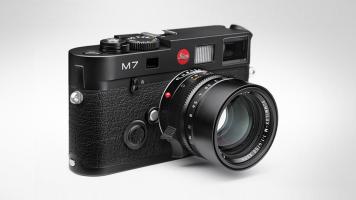
It has taken me a while, but, over the course of many years I’ve come to understand what makes die-hard Leica lovers tick. Craftsmanship is certainly part of the reason. All of Leica’s M (digital and analog), Q, CL, and TL-series cameras are manufactured in Germany, from brass and metal alloys and plastic parts—only where it makes sense to use plastic. Although Leica’s newer digital cameras are the driving force behind the company’s very existence, analog film cameras remain the theology behind the company’s mission statement.
Leica currently

by Allan Weitz ·Posted
In the 78 years that Kodak Tri-X has been in existence, there have been finer-grained or faster films available, as well as films with more exposure latitude, better contrast, and even better tonality—but none of them have the signature look and the history of Tri-X.
Tri-X was originally released in 1940 as a 4 x 5" sheet film, followed by 35mm and 120 roll film versions, in 1954. It wasn’t long before the name Tri-X became synonymous with black-and-white
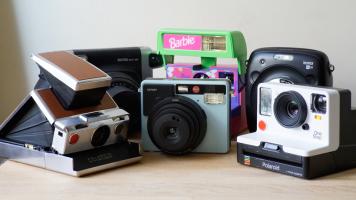
It’s not news that instant film has been booming once again in recent years, and 2017 has proven to be a hallmark year for the genre, with new cameras and films being introduced. With a niche that has gone from near extinction to one of the most popular and fun format of photography today, and the subsequent overwhelming number of options on the market today, here’s a look at everything there is to offer.
The Cameras
While all grouped into the genre of instant-film photography, we can further split this into two sub-genres: instax and Polaroid

As film continues its resurgence, 2017 saw several introductions to the photography world that continue to inspire film enthusiasts everywhere. Ranging from new films, the rebirth of an old film, new cameras, and even digital innovations for film shooters, 2017 marks another year for film’s regrowth in popularity.
Polaroid Originals
One of the most exciting new, or sort of new, prospects in the film game is Polaroid Originals. Picking up where Impossible left off, Polaroid Originals is the rebranded continuation of the company that kept
by Allan Weitz ·Posted
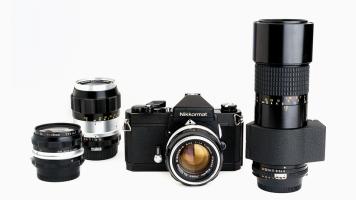
Single lens reflex cameras (SLRs) began arriving on our shores from post-war Japan during the mid-1950s. Though reflex viewing systems have been around since the first camera obscura was introduced, in 1676, consumers had to wait until 1936 when Exacta introduced the Ihagee Kine, the first consumer 35mm SLR. Other companies soon joined the party. In 1959, Nikon raised a number of eyebrows when it introduced the Model “F”, a camera
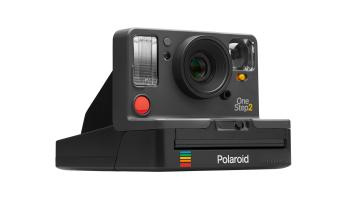
Many of us were wishing for this day with little hope that it would ever come, but the Impossible Project has managed to bring back the original instant film name with its announcement today of Polaroid Originals. This rebranding was made possible through a years-long effort by the leaders of the Impossible Project and represents a major shift in things to come, including the release of a brand new instant film camera bearing the Polaroid name—the