Photography
- Recently Added
- Popularity
- Name
About 422 filtered results

by Mathew Malwitz · Posted
When it comes to choosing the right camera, there’s often a gap between the small, pocketable point-and-shoot cameras and larger mirrorless ones. While interchangeable lens mirrorless cameras have much to offer, their higher price points and larger form factor often make them unfeasible for the average photo enthusiast. It often leads to the question of how a photographer can bridge that gap.
Enter the aptly named

by Bjorn Petersen · Posted
When assembling a kit of lenses for photographing a wedding, one should take into consideration the location in which the wedding is taking place, the number of guests and, of course, the type of imagery you are seeking to create. To best represent a wedding in a dynamic manner, it is often preferable to have a range of lenses to achieve different perspectives of the event, rather than maintaining a constant perspective of your subject matter. A wide-angle lens, specifically, is a highly effective tool for capturing many of the scenes that

by Todd Vorenkamp · Posted
Many interchangeable-lens cameras, be it DSLR or mirrorless, are sold today with what we call "kit" lenses. Current kit lenses, in general, thanks to computer technology and advanced manufacturing techniques, are more capable and of higher quality than those of yesteryear. However, many of us who use interchangeable-lens cameras feel the gravitational pull of other lenses that are not yet in our bags.
Adding lenses to your quiver is all about choices and selection and, in photography, we often find ourselves at a sort of "gear crossroads." The

by Mathew Malwitz · Posted
We can say from experience that there’s nothing worse than your fingers freezing while on a winter photo shoot. From a scientific standpoint, exposure to the cold results in constriction of blood flow to the extremities, resulting in rapid temperature loss that approaches ambient temperatures. In layman’s terms, your hands get cold fast. Once you feel that chill, it’s nearly impossible to think about anything else.
Enter gloves. From mittens to liners, we all probably have more pairs of gloves than we know what to do with, but not all pairs

by Luke Rollins · Posted
Like a painter choosing a paintbrush, a photographer’s lens choice will dramatically affect the resulting picture. This is especially true when it comes to landscape photography. Lens choice can make a big difference when you don’t have the benefit of directing your subject. A mountain will not turn its face toward the sun, no matter how hard you beg. As a result, your creativity is limited to a couple of key factors, such as time of day, weather, and―you guessed it, lens choice.
Similar to the range of unique considerations to keep in mind

by Rebecca Melville · Posted
An on-camera flash is an indispensable accessory for many photographers. While it provides light to supplement dark conditions, an on-camera flash also allows you to achieve more balanced exposures in daylight conditions, permits freezing of fast-moving subjects, and can even be used to control other flash light sources. With so much to offer, an on-camera flash can become an integral part of your workflow, but where do you start? We are going to give you the on-camera flash rundown with everything you need to know to make the most of this

by Todd Vorenkamp · Posted
Choosing a lens is a highly personal choice, and that’s especially true for wildlife photography. This is in the realm of the telephoto lens after all. While almost any focal length lens works for landscapes and other types of photography, in general, when it comes to photographing animals in the wild, you'll want to have the longest reach you can. In this guide, we’re going to discuss the factors one should consider when purchasing a lens for wildlife photography.
Focal Length
The first and most straightforward factor to consider is focal

by M. Brett Smith · Posted
Whether you’re an experienced astronomer or deep-space dilletante, finding the best telescope is no easy task. During the ’scope selection process, you’ll need to consider several factors, including telescope type, viewing application, magnification power, and more.
To help you find the best telescope for your astronomical ambitions, we’ve put together a list of some of our favorite ’scopes and separated

by Luke Rollins · Posted
Macro photography never ceases to amaze me. Show me the face of a jumping spider reproduced at life-size or greater and I’ll undoubtedly stop what I’m doing and stare at it for a while. What’s interesting is how ultra-wide-angle lenses, which are available for DSLRs and
by Luke Rollins · Posted
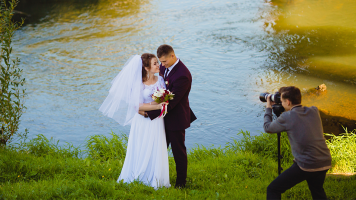
Many hobbyists reach a turning point in their craft when they decide to pursue wedding photography seriously. With the transition to pro comes the task of updating your lens kit accordingly, and most photographers would agree that investing in quality glass is essential. Unlike the rapid turnover of camera bodies, lenses will last for years and can make all the difference in creating quality images. Understanding what some of the best available options are will help you invest appropriately.
What to Consider
Weddings are long affairs, often

by Todd Vorenkamp · Posted
There are many ingredients in the recipe that make a good photographic portrait—foreground, background, setting, pose, expression, color, lighting, and so on—but one element that can be as important to the result as the portrait sitter is the lens used to capture the portrait and help create the art.
Technically, any lens can be used to take a portrait with your camera, and there are traditional focal lengths for “portrait lenses” like 85mm and 105mm, but I asked my fellow B&H photographers, as well as our B&H Creative partners and

by Mathew Malwitz · Posted
Wedding and portrait photographers looking for a lightweight, compact system with exceptional performance need look no further than the FUJIFILM X cameras and lenses. While the size and weight advantage of mirrorless cameras spans from Micro Four Thirds to full frame, the APS-C sensors in the FUJIFILM X system allow the cameras and lenses to be relatively small and light. Full-frame mirrorless is attractive to many, but the portability advantage of APS-C sized lenses is not to be understated.
For those looking to one-up the full-frame shooters

by Mathew Malwitz · Posted
Food photography is an undeniably popular artistic medium, involving all kinds of people and gear to make those mouthwatering shots possible. If you’re an aspiring food photographer or someone looking to take their existing work to the next level, we’ve put together a special, themed gift guide that’s perfect for any skill level.
1. A 50mm Lens
Whether you are far into your photography career or just starting out, whenever you complete a dish in your kitchen or have a plate placed in front of you at a restaurant, there’s no better starting

by Mathew Malwitz · Posted
Are you interested in the wide and wonderful world of photography? Well, you’ve certainly come to the right place! Check out this short checklist of a dozen items, designed to get you started in digital or film photography and headed in the right direction.
1. Interest
The first thing you need is an interest in photography. If you are reading these words, you likely already checked that box. If you are debating whether to take the dive into photography, you might want to give it some careful thought, or cater your purchases toward your level

by Todd Vorenkamp · Posted
Close-up or macro photography is an incredible way to capture the tiny world around us on a super-detailed level. While the dedicated macro lens is still one of the best tools for exploring the world on a miniature scale, there are some very inexpensive ways to jump into macro photography with the lens or lenses you already own—no need for a specialized close-up macro lens. In this article, we will take a closer look (no