Photography
- Recently Added
- Popularity
- Name
About 91 filtered results

by Josh Taylor · Posted
Many experienced photographers think of fast moderate telephoto lenses, as “portrait lenses” because so many professional portrait photographers rely on them. Lenses in the 85-105mm focal length range with maximum apertures between f/1.4 and f/2.8 can capture frame-filling headshots and head-and-shoulders portraits at moderate shooting distances, thus minimizing apparent perspective distortion—the dreaded “big-nose effect”—in close-ups. And they deliver very shallow depth of field at their widest apertures, creating compelling pictorial

Posted
Let's take a look at the Nikon NIKKOR Z 400mm f/2.8! Made for Nikon's Z mount, this super-telephoto lens is perfect for sports and wildlife photography, with a maximum aperture of f/2.8 and built-in 1.4x teleconverter, as well as sophisticated optical, autofocus, and VR systems.
What would you capture with this camera lens? Let us know below in the Comments section!
by Bjorn Petersen · Posted
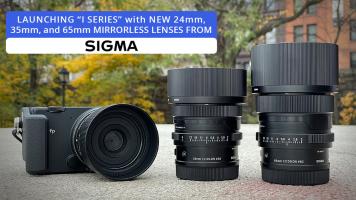
Continuing to add to its growing DG DN lineup of full-frame mirrorless lenses, Sigma has just released a trio of new lenses, along with a new designation for lenses that are sleek and stylish. Introducing the 65mm f/2 DG DN Contemporary, 35mm f/2 DG DN Contemporary, and 24mm f/
Posted
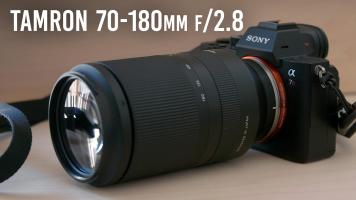
In this lens review, Jake tests the Tamron 70-180mm f/2.8 Di III VXD in both photo and video scenarios. Compact and fast, this lens was specially designed for full-frame Sony E-mount cameras and rounds out Tamron's offering for this series.
And while you're contemplating your next lens acquisition, watch our hands-on review of the

by Allan Weitz · Posted
Most photographers use sharpness as qualifier to rate the quality of their lenses, but as any seasoned photographer can tell you, resolution isn’t the end-all when it comes to ranking lens qualities. If anything, it’s the character of a lens—the way it renders your subject, that determines the quality of a lens. In this article, we will discuss lenses that bring something special to the party—lenses that break from the rest of the pack.
Pinholes
Some of the earliest photographs were captured with cameras obscura, which have evolved into

by John Harris · Posted
I am in a year-long quest to find the right camera/lens combination that will give me a wide-angle (24mm, 28mm, or 35mm equivalent) fixed focal length setup for everyday carry and general street photography. I have been experimenting with small form factor mirrorless and point-and-shoot cameras such as the Sony a6500 and FUJIFILM X100F
by Allan Weitz · Posted
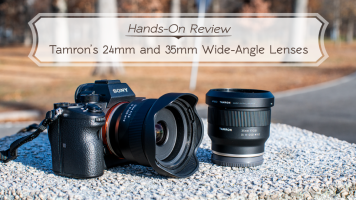
I'm a big fan of smaller, lighter camera gear, so when Tamron announced a trio of lightweight, compact prime wide-angle lenses for Sony E-mount cameras, I took notice. Included in the lineup are the 35mm f/2.8 Di III OSD M 1:2 and 24mm f/2.8 Di III OSD M 1:2, which will be available any day now, and a
by Jill Waterman · Posted
Type the tagline “Pro Quality Amateur Prices” into Google and watch links to the company Neewer float to the top of your feed. Founded in 2010 with an initial set-top flash, Neewer has grown to incorporate inexpensive LED on-camera lighting and ring lights popular with the beauty blogger set, while also expanding into microphones and audio accessories, tripods and stabilization gear, as well as lenses, filters, bags, and various other accessories for photo, video, and audio markets.
Location photographs © Jill Waterman
According to its website
by Cory Rice · Posted
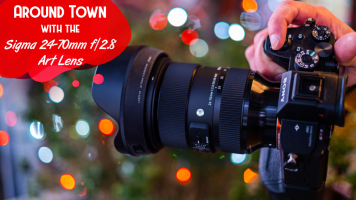
The 24-70mm f/2.8 lens is a perennial favorite among photographers who prefer to travel light. As a someone whose heavy rotation rotation consists of hefty 35mm, 50mm, and 85mm prime lenses, a fast 24-70mm has long lingered in my mind. So when I was asked to review Sigma’s 24-70mm f/2.8 DG DN Art Lens, I jumped on the opportunity to see how well it could stand in for my usual trio.

by Bjorn Petersen · Posted
Everyone loves a nice 24-70mm or a simple 50mm lens, but nothing generates instant intrigue and interest more than a unique focal length or lens design you’ve never seen before. Whether it’s an ultra-wide-angle lens, impressively fast design, or it just has some kind of distinct trait that separates it from the norm, unique lenses are a sure way to add some character to your imagery. Despite 2019 being a foundation-building year for many manufacturers, with many lens releases focusing on core sets of standard primes and zooms, here’s a look at

by Bjorn Petersen · Posted
After experiencing an especially prolific 2019, Tamron has been picking up speed over the past few years and reinvigorating its lens lineup with popular new options for both SLR and mirrorless systems. Splitting these releases between the two camera types, Tamron also makes a point of developing lenses specifically for mirrorless or for SLR, versus using the same optical design for everything. This helps to achieve smaller designs for mirrorless and retain the integrity of the SLR designs for the larger camera systems.
Looking at the SLR
by Bjorn Petersen · Posted
Considering it was more of a “camera year” for Fujifilm, 2019 still saw the release of four new lenses split between its two mirrorless systems. Already possessing a mature X system and a solid lineup of G-mount lenses for this company’s quickly growing medium format system, Fujifilm spent the year filling in some gaps in the two optics lineups with versatile zooms and compact primes.
For the APS-C-format X-mount system, Fujifilm started the year by adding to its immensely popular series of compact primes with the
by Bjorn Petersen · Posted
Sony, a frontrunner in the mirrorless game, had a productive 2019 that saw the addition of six new E-mount lenses to its lineup. Including two new APS-C lenses and three new FE telephoto lenses, Sony is gradually working on filling the missing gaps in its system, which is to be expected from one of the more mature camera systems at this point. Whereas recent entrants to the mirrorless, full-frame or otherwise, realm are building the foundations of a system, Sony has the luxury of refining its own lineup and has begun to cater to more niche

by Bjorn Petersen · Posted
Dedicating its year to Z, Nikon spent 2019 actively working toward building up its cache of lenses for the immensely popular Z 6 and Z 7 cameras, as well as initiating a DX-format system for the Z mount. Continuing to add to a series of highly useful primes, Nikon’s optics team also spent 2019 releasing a pair of useful FX zooms, a pair of DX zooms, and finally formally releasing the new Noct. With the exception of the Noct, Nikon’s strategy with the Z-mount lenses has been a seemingly more modest one than other recent entrants to the full-
by Bjorn Petersen · Posted
In 2019, Canon had one clear objective for lens development: strengthen and add to the RF system. Following up on an exciting 2018, which saw the release of the EOS R, and the early 2019 release of the EOS RP, this year Canon announced six RF lenses, ranging from a wide zoom to a specialized portrait prime. Straying from competitors, Canon has