Video
- Recently Added
- Popularity
- Name
About 1841 filtered results
by Mary Latvis · Posted
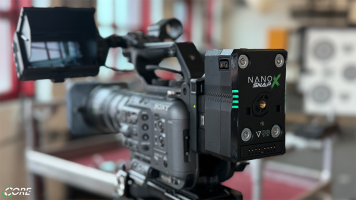
Experienced cinematographers and videographers know that shoot days can run the gamut from capturing absolutely every second of a “reality show” star’s day to the more measured pace of a dialogue-based feature that may even, time permitting, include rehearsals. The new NANO X SNAP 99Wh Li-Ion Battery from Core SWX has a modular, scalable design that covers your power needs for this wide variety of production scenarios.
by Steven Gladstone · Posted
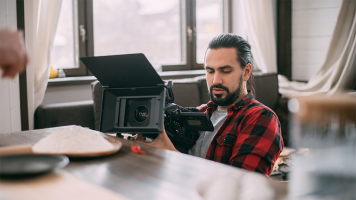
In this article series, we will take a look at five different production styles and come up with suggestions for camera accessories suitable for that style. This article will cover a range of different camera bodies and should provide a foundation for building out your camera package. Please note that for the purposes of this article, I will be excluding smartphones as well as action cameras, focusing instead on accessories for camcorders, DSLRs, mirrorless, and digital cinema cameras. Remember, if you go to the product page for your camera on

by Zack Young · Posted
With all the time and effort it takes to set up a virtual production volume, it’s vitally important to schedule regular maintenance on your LED panels to ensure they stay clean, calibrated, and ready to be used at a moment’s notice. Knowing how best to repair, store, and transport cabinets is also an important part of lengthening the lifespan of these hefty investments. The number one resource is always going to be the documentation that came with your OSVP panels, whether that be a manual, an online database, manufacturer best practices, or

by Zack Young · Posted
A media server is a key step in the on-set virtual production (OSVP) pipeline, sending assets like background plates, LUTs, and tracking data over a network so that they can be used to create unique real time in-camera virtual effects (ICVFX). Whether it be a rendered set from Unreal Engine or an uncompressed prerecorded background plate, the media server is what stores and transmits these virtual pieces to the LED walls and processors. Let's dive deeper into what these servers do.
What's Important in a Media Server?
Media servers for virtual

by Mary Latvis · Posted
Optimal imaging for virtual production (VP) requires certain camera functions that are not integral to all video cameras. A global shutter (or fast readout speeds), genlock capability, and timecode input are key factors to look for when selecting a camera for your VP video capture. Let’s review these specifications and highlight several cameras that incorporate these key specs.
Global Shutter Sensor
Most video cameras are designed with a “rolling” shutter that successively scans each row of photosites (the physical embodiments of pixels) on

by Zack Young · Posted
Thypoch has unveiled the new Simera-C 16mm T1.9 full-frame cine lens, available in E- and M-mounts, along with a Simera-C six-lens kit and custom foam inserts. The 16mm is now the widest focal length in the series, with a 106° field of view. At T1.9, it’s a tad slower than the T1.5 maximum aperture seen in the rest of the line, but still quite impressive for so wide a focal length. The 6-lens kit, also available in E- and M-mounts, contains the 16mm, 21mm, 28mm, 35mm, 50mm, and

by Mary Latvis · Posted
Large-scale LED signage display walls have been a boon for retailers, sports broadcasts, and live events, providing clear viewing and immediate content updates. The LED volume walls used for OSVP (On-Set Virtual Production) take these massive displays a step further, upping multiple specs to produce stunningly lifelike, high-resolution video that serves as an immersive backdrop for capturing live talent and creating

by Jordan Gallant · Posted

by Steven Gladstone · Posted
Welcome to Part 2 of Keys to a Happy and Healthy Production Life.
Hopefully you’ve read Part 1, but if not, be sure to check it out.
Working on productions, and making films at every level can be fun, exciting, thrilling, and rewarding. The key to longevity in the business is both being easy to work with and being valuable to those who hire you. If you’re a director, you must figure out how to balance getting what

Posted
Doug discusses more advanced concepts to help deepen your understanding of frame rates. Both editors and videographers will find this video useful, since it will allow them to work in better tandem. We'll cover timecode basics, fractional frame rates (such as 29.97 fps and 23.98 fps), variable frame rates, and more.
0:00 - In This Video
0:39 - Timecode & Drop-Frames
5:36 - Variable Frame Rates
7:02 - Interlaced Video
10:34 - Telecine & Pulldown
12:47 - Mismatched Frame Rates & Refresh Rates
14:54 - Practical Tips

by Steven Gladstone · Posted
Productions tend to fall into two categories—a disorganized mass of people scurrying around to somehow get the shot off as the sun goes down, leaving crew and cast exhausted at the end of the day, or a smooth moving production that is more like a complex dance, though not as frenetic, far less exhausting, and far more efficient. If you are only going to be working on a film/video production a single time, then the maddening chaos of the first type of production will probably feel very satisfying. However, if you are looking at working in the

by Zack Young · Posted
Canon has unveiled the EOS R6 V, a new full-frame RF-mount camera capable of 7K open gate recording, active cooling, 5-axis in-body stabilization, and Dual Pixel CMOS Autofocus II. This compact video-forward body is ideal for content creation, streaming, podcasting, and a host of other modern production scenarios. Releasing alongside the EOS R6 V is a new
Posted
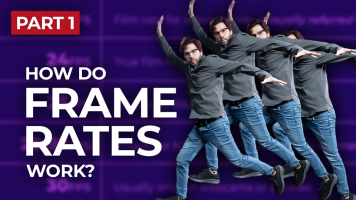
Frame rates are one of the most fundamental ideas to understand when it comes to technical and creative decisions for your films. It's important to know how frame rates work so you know how they'll affect the final film or broadcast. So, what frame rates are typically used? Why is 24 fps the standard for movies? Are higher frame rates better than lower ones? Join Doug for a crash course on the basics of frame rates.
0:00 - In This Series
0:46 - What Is a Frame Rate?
2:21 - Creative Uses of Different Frame Rates
3:21 - Is a Higher Frame Rate

by Steven Gladstone · Posted
This article is an introduction to virtual production using photogrammetry and lidar. In this article I will discuss what photogrammetry is, and how advances in lidar scanning allow you to use it in pre-viz as well as production.
What Is Photogrammetry?
Simply put photogrammetry is the process of creating a 3D image, or gleaning 3D information about a location from 2D images. Essentially you use a series of 2D images to create a 3D “map” of a surface, area, or room.
Why Use Photogrammetry?
Photogrammetry enables you to make realistic and

by Jennifer Hahn · Posted
Keep your lighting nimble in any shooting environment with the new Omnibar LED linear light fixtures just announced by ARRI. These narrow LED lights come in 2’ and 4’ lengths and in black and classic ARRI blue/silver housings, and they are packed with features, including daisy-chaining, IP65 weatherproof, wireless remote control options, magnetic optics, and a built-in battery. The lights come in multiple packages to fit your workflow.