Video
- Recently Added
- Popularity
- Name
About 207 filtered results

by Steven Gladstone · Posted
Steven Gladstone: You wear many different hats—writer, producer, director, actor, etc. Do you go by Filmmaker, or is there a distinction?
Gregory Blair: If I’m relegated to a single label, I use “Entertainment Professional,” because it is generic and inclusive enough to represent my writing consulting, TV, and theatre work in addition to my various roles in the film industry.
SG: How long have you been working in the industry, and how did you get started?
GB: Seems like forever, but I didn’t really start until I was in my twenties and, despite

by Steven Gladstone · Posted
Making a complete film that lasts only a minute takes far more time to shoot and edit. Kelly Murray and Hillary Hanak opened up to me about what was involved in making the one-minute-long horror film, 3:13.
Steven Gladstone: How long have you been working in the industry, and how did you get started?
Kelly Murray: I've been working in film for seven years, since 2012. Growing up, I was involved in the arts and was a strong writer, so I studied English literature and writing at college. I was, however, involved in the University's student

by Steven Gladstone · Posted
I had the opportunity to catch up with Jillian Bullock, the filmmaker and creative force behind A Sense of Purpose: Fighting for Our Lives, and she shared some thoughts on making the film and the filmmaking process in general.
Steven Gladstone: How long have you been working in the industry, and how did you get started?
Jillian Bullock: I’ve been in the industry since 1991 when I graduated from La Salle University and got an internship on the set of Spike Lee’s movie, Malcolm X.
SG: Did you go to school to learn about filmmaking?
JB: I went to

by Steven Gladstone · Posted
In this segment of Show Us Your Shot, filmmaker Jillian Bullock filmed a scene in Fairmount Park, in Philadelphia, in the summer: “We headed out early to beat the heat, but we had a problem with the DJI Ronin Gimbal, which wasn’t cooperating. This meant we had to do more takes of the scene. I made sure we had plenty of water bottles available for cast and crew. More care was given to the lead female actor, Tamara Woods, who was pregnant at the time. We kept taking breaks in order for her to hydrate and get a little rest. I told her to stand in

by Steven Gladstone · Posted
The filmmakers behind Clickbait, Michael Epstein and Sophia Cacciola (collectively Filmmakers), share some thoughts on their film and filmmaking.
Steven Gladstone: How long have you been filmmakers, and how did you get started?
Filmmakers: While we’ve each had a lifelong interest in film and filmmaking, we really started out being dedicated to music and songwriting. We toured in many bands over the years and, around 2008, we decided that we really

by Steven Gladstone · Posted
In this segment of Show Us Your Shot, filmmaker Sophia You, Executive Producer Samantha Tan, and Creator Jenna Lam guide us through the filming of an episode of Ambitious, a web series about an Asian-American girl who cannot seem to find a place where she feels she belongs. In the final scene of the series’ finale, she placed the two main characters inside a frame within a frame to suggest that they cannot escape the situation in which they find themselves and must draw closer to each other, literally and metaphorically, to have an honest

by Steven Gladstone · Posted
In the segment of Show Us Your Shot, Director Roderick E. Stevens and Cinematographer Daniel Gonzalez explored a few options for safely capturing the driving scenes in this road movie, including using a 70" LED TV as a background, before settling on green screen for compositing. This also freed Stevens up to manipulate the art direction and color grading further to create a contrast between the heightened, almost surreal first half against the familiar reality of the latter half.
Roderick Stevens’s Bio

by Steven Gladstone · Posted
In this segment of Show Us Your Shot, filmmaker Jillian Bullock explains how her DP created a desert shot at night, while shooting in Pennsylvania.
We had filmed some scenes at the Bill Pickett Riding Academy, in Philadelphia, a horse-riding stable. My DP, Lamont Fountain, and I were there trying to figure out where we could shoot to make it look like a battle area in Iraq or Afghanistan. Since we were shooting at night, we figured we could fake out a spot in the woods behind

by Steven Gladstone · Posted
In this segment of Show Us Your Shot, Gregory Blair pays homage to indie horror filmmakers, creating a disorienting feeling without the use of high-tech effects, CGI, or jibs and cranes.
“Deadly Revisions is a psychological thriller that pays homage to several horror films and filmmakers. In this scene, we wanted to give a loving nod to Sam Raimi and the Evil Dead films. The scene involves Bill Oberst Jr. as Grafton Torn—a horror-film writer with amnesia, haunted by nightmares—who is having a sort of breakdown/hallucination moment. We

by Steven Gladstone · Posted
In this segment, Chris Seivard shares with us how he pulled off a professional shoot for a client, using mostly natural daylight streaming through the location’s windows, supplemented with two LED fixtures to light the interior. Watch the video, as Seivard explains his setup, and be sure to study the lighting diagram.
This project was for an insurance company. The goal was to give investigators a feel for what the deposition process might be like, after an incident investigation.
by Justin Dise · Posted
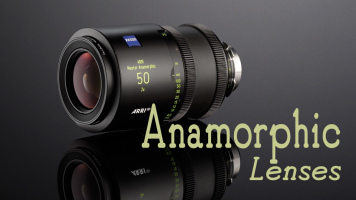
What began as a tool and technique for capturing and projecting wider aspect ratios on 35mm film, anamorphic lenses are a runaway favorite among cinematographers for the unique characteristics they bring to moving images. Ultra-wide rectangular aspect ratios, long horizontal lens flares, and oval bokeh (the out-of-focus areas of the image) now feel as much a part of the cinematic experience as a bucket of popcorn and a liter of soda.
So how do anamorphic lenses work? The term anamorphic derives from the Greek words meaning ”formed again.”

by Steven Gladstone · Posted
In Learning to Drive, Director Roderick E. Stevens wanted the camera to drop straight down over the actor, the way it might on a telescopic crane. Without the budget to rent one, that seemed impossible. It’s a simple shot that only lasts a few seconds, but it occurs at a crucial turning point in the film, and the director is far too stubborn to give up. About $150 in electrical conduit and hardware and some funky engineering resulted in a vertical slider that accomplished the shot.
Roderick Stevens's Bio

by Steven Gladstone · Posted
In this segment of Show Us Your Shot, filmmaker Steven Gladstone shares with us the differences between a dolly and a zoom. He begins by recreating a two-dolly combination move using a skateboard dolly and a slider, and then moves on to examine the choice between zoom in and dolly in. “With the small size and lightweight nature of today’s equipment, once-difficult shots become easier to pull off. I took this opportunity to try the shot with a dolly and a zoom, and it makes a great illustration of the differences between the two.”
About

by Steven Gladstone · Posted
The test involved an actor, dressed in a cowboy outfit, lighting up and smoking a cigar. The test was done late in the day, with no additional lights, and we were racing against the sun. The green screen we had was a little bit on the pale/unsaturated side, but we went ahead with it anyway. We imported the footage into Final Cut Pro and applied the Keyer effect.
Most of it was working well, except there were some areas that were bleeding through the image so we tried to clean that up with the addition of masks/garbage mattes. You can see where