Outdoor Photography

When winter rolls around, many bird photographers choose to hibernate like a bear or fly south like a bunting. However, with a few precautions and considerations, winter can be an excellent time of year to photograph birds, even in the northern climates. Over the years, I have made dozens of trips to photograph birds in some pretty extreme locations, such as the high arctic, northern Michigan, and northern Minnesota. In this first part of my two-part series, I will share my strategies to prepare yourself and your gear in the best ways for

While the specific origin remains fuzzy, an early appearance of the term Leaf Peeper—or Leaf Peeker, as initially used—is said to have surfaced as a newspaper headline in 1960s Vermont. Foliage tourism is legendary all over New England, but the neighboring states of Vermont and New Hampshire offer up a kaleidoscopic adventure in a tidy nutshell. Their shared border, similar shapes and compact size—respectively ranked as the 45th and 46th smallest states in the nation—is a handy springboard for a wide range of pictorial opportunities.
Above

My 100 Nights project has opened my eyes in other, unexpected ways. Inspiration comes in many forms. Sometimes it’s the environment that inspires me. On this particular night, in Iceland, last March, my friend David Wilder and I had been chasing clear skies to photograph the aurora. We started off at the famous Glacier Lagoon. We had scouted potential compositions in the daylight and were able to get a few aurora shots before crowds and clouds (surprise, surprise) thwarted our plans. We

So far, the weather is definitely the biggest challenge I’ve experienced in my 100 Nights project. So much so, that I could have called the project 100 nights of bone-chilling cold. Seriously, I keep finding new limits to the amount and duration of cold I can endure. I can’t even tell you how many nights I’ve shot in temperatures below -30° Celsius in the Canadian Rockies. But somehow, I keep coming back for more!
I joke that my camera batteries last longer than I do, because I leave my cameras running while I sit in the car trying to get warm

0 Plays ·Posted
This week, we welcome two photographers who know the joys of spending a late afternoon waiting for super cells to form, or that perfect lightning strike to appear, as well as the perils of rising waters, golf-ball-sized hail, and projectile debris in flight. Our topic today is extreme-weather photography, and we welcome photographers from two different continents to tell us about their shooting styles, safety precautions, gear, and their general thoughts on weather, social media, and the photography business.
We are joined first by

by Sarah Hiance ·Posted
Adventure has always presented itself as an avenue of nosy exploration into worlds I knew very little about. It was a spark of curiosity and wonder that swept me, at a very early age, into the unknown. Kentucky has many natural wonders to explore, but my favorite growing up were a set of abandoned river stone steps buried deep in my backyard, compacted by fermented leaves, slick twigs, salamanders, and clouds of mosquitos. Days were spent excavating these steps with my Mom’s garden shovel, and a paint brush, and the collection of fossilized

0 Plays ·Posted
This is one of the more informative and hands-on practical episodes of the B&H Photography Podcast that we have produced in some time. Obviously, it helps if you are “practicing” car photography, but the insights provided in this episode are useful for a wide range of photo disciplines, and touch on techniques for making better images of moving objects, reflective and non-reflective products, tight interiors, and how to photograph large items in a studio or on location.
For this
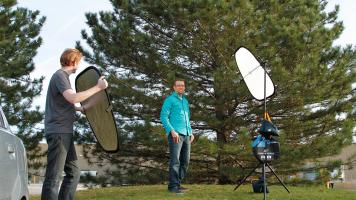
Generally, photographers are taught to shoot in the early morning hours, or around the “Golden Hour” (sunset/twilight hour) for the best light, because the light of midday afternoon is too harsh or too bright for making well-balanced exposures. However, if we were limited to just those nominal number of hours per day to capture a photo, we would miss many opportunities for great photos and decisive moments.


Adventure Week is back! This time, we're heading out into the cold for some wintry excitement. Starting Monday, January 28th, join us as we ski, snowboard, and snap a polar-bear pic or two. Each day, we'll be highlighting a different adventure, providing details on how we did it, the gear we used, and showcasing all the exciting footage we captured along the way. We'll also be publishing plenty of reviews, buying guides, and tips and tricks to help you embark on an adventure

When most of us think of “sports photography,” we immediately think of iconic images from the world of land-based sports—American football, track and field, boxing, baseball, and others. One could argue, however, that yacht racing and sailing regattas provide the canvas for some of the most spectacular images in all of sports. And, if you have spent time around the water, seen the framed print on the wall of my physical therapist’s office, or flipped through the pages of any sailing magazine, you might have noticed that professional sailboat

As a follow-up to Part 1 of our fireworks story, it’s worth noting that photographing a fireworks show is no easy feat. Readers seeking a how-to guide to this subject need look no further than this Explora article, by Todd Vorenkamp.
Yet, as that article notes, and the photos featured here make evident, the challenge of capturing bursting pyrotechnics in images offers great opportunities for experimentation and fun. This is perhaps

There is perhaps no truer sign of summer than Independence Day in the United States. The Fourth of July is when the summer season kicks into full gear, with barbeques, pool parties, family gatherings, and road trips galore—not to mention the fireworks!
One lead-up to this holiday that I will never forget found me hurtling down the New Jersey Turnpike at sunset in a Greyhound bus. As the twilight deepened, bright bursts of fireworks began shooting up past the tree line, close by and at a distance, reflecting in the darkened glass of the

The lighthouse may be history’s only example of a man-made structure erected in the middle of a scenic vista that did not cause public outcry and protest. You don’t have to be a lifelong sailor to appreciate the beauty of the world’s lighthouses. Even the lighthouses that fail to grace the pages of coffee-table books and the front of potato-chip bags are fantastic in their own ways. Mariner and landlubber alike often find their cameras pointing at these lantern-topped buildings, and releasing the shutter to yield stunning lighthouse

Cristina Mittermeier was hardly seeking to change the world with photography when starting her career as a marine biologist. Trained as a scientist and armed with a degree in biochemical engineering in the exploitation of marine resources from the Monterrey Institute of Technology and Higher Education (ITESM), in Mexico, Mittermeier’s early work consisted largely of scientific papers filled with the hard data of numbers and words. A prime influence in her work was biologist Paul Ehrlich’s 1968 book, The Population Bomb, which she read as a