Photography
- Recently Added
- Popularity
- Name
About 12 filtered results

Posted
Learn how to get the most out of your camera so you always take incredible wildlife and bird photos. Join Matt in the Everglades as he discusses how to set up your camera settings so you never miss the shot.
0:00 - Intro
0:45 - Autofocus Settings
3:41 - Spot Metering
4:19 - Shutter Speed
6:03 - Frames Per Second
6:52 - Pro Capture
7:58 - Focal Length, Primes vs. Zooms
9:59 - Putting It All Together/In-Field Example
12:08 - Final Thoughts
Sponsored by
Posted
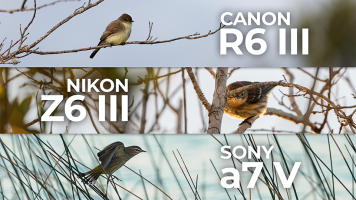
Looking for a full-frame camera for all your bird photography needs, but aren't looking to go overboard on spending? Matt shares 3 midrange camera options (the Canon R6 III, Nikon Z6 III, and Sony a7 V) for the photographer that is ready to take that next step. Buying a camera at this price point means investing in a system, so Matt will also discuss lens options based on your budget!
0:00 - Intro
0:55 - Sensors, Read Out Speeds, Frame Rates
3:12 - Pre-Capture
4:27 - Lenses/How to Choose a Lens
7:34 - Animal Autofocus (Camera & Lenses)
8:

Posted
There's a FUJIFILM camera out there for everyone. With all these options, it can be hard to find the right one for you. Do you want a compact camera you can quickly grab? Do you need a video-centric or hybrid camera? Or, are you photographing weddings and need the highest quality? Juan demystifies FUJIFILM's lineup, so you can find the right one for your work.
0:00 Intro
0:53 Fixed Lens
4:13 X-Series
7:21 X-Series Professional Hybrid
8:47 GFX Series
10:58 Final Thoughts
Sponsored by

by Mathew Malwitz · Posted
Imagine, if you will, a photo shoot. Your subject is a striped, orange cat bouncing off of the walls. You have your camera raised to your brow, finger on the trigger, waiting for the perfect pose. He turns his gaze toward you, but his head is constantly moving. No matter, you quickly fire a few frames, figuring that you finally nailed the shot. You check your shots, only to see a series of blurry portraits.
If this sounds like a situation you’ve been in before, we know the feeling. That’s why, today, we’re taking a look at settings for pet

by Mathew Malwitz · Posted
Getting a new camera is always an exciting affair. Whether it’s your first interchangeable lens camera or a long-awaited upgrade, there’s almost always new features to explore. Mirrorless cameras are especially exciting as they bring new and intuitive features that boost creativity while making photography easier than ever! Whether you’re new to cameras, shopping for one, or looking to dust off an old hobby, let’s get into setting up our new mirrorless camera.
What Is a Mirrorless Camera?
It’s not often something is named after a feature it

Posted
Did you know that the type of lens you choose affects the story you want to tell, whether you're a photographer or a filmmaker? There's ultra-wide, wide angle, normal, telephoto, medium telephoto, and supertelephoto. That's a lot of terminology, so if you're lost, Sidney's here to explain what focal lengths fall under each umbrella and they change your storytelling.
0:00 - In This Tutorial
0:25 - Focal Length & Field of View
0:56 - Sensor Size
2:10 - What We'll Cover
2:31 - Wide Angle Focal Lengths (Below 20mm)
4:13 - Normal Focal Lengths

by Mathew Malwitz · Posted
When photographing a wedding, we face a wide array of lighting conditions, ranging from bright sunlight to dimly lit interiors. Photographing in any of these scenarios is a challenging endeavor, with our exposures pushed to their limits and our post-processing routines shaken with heavy edits.
Many photographers opt to shoot with ambient lighting, and clients may prefer this style as well. Natural light has an organic look to it that flash seldom

by Mathew Malwitz · Posted
Winter is one of the most exciting seasons for wildlife photography. Northern species return to their wintering grounds and bring life to an otherwise cold and barren landscape. Photographers and bird watchers alike yearn for this time of year, as owls and other birds of prey become more common. One of the most visited and coveted winter birdwatching spots in the US is the famous Sax-Zim Bog.
Nestled in the rural hills about an hour northwest of Duluth Minnesota, Sax-

Posted
Even for the minimalist wedding photographer, investing in these pieces of camera gear can improve your workflow and images. Lotta shares her must-have accessories that will make your job photographing weddings easier.
0:00 - Intro
0:21 - On-Camera Flash & Bouncing Light
1:06 - Off-Camera Flash
1:17 - Camera Straps & Harnesses
1:56 - Camera Bags
2:46 - Filters

by Mathew Malwitz · Posted
When you first head out to take photos of wildlife, what’s the first thing you think of? If it’s not lighting, we’ve got news for you. Photography is, by definition, the capture of light on a light-sensitive surface. The word “photograph” is derived from Greek roots that translate to “drawing with light.”
We can have the most expensive camera and lens combo, but without good light, we’ll never get the most out of it. Understanding our primary light source and its many qualities is essential to improving as a wildlife photographer, and in this

by Luke Rollins · Posted
Subject and style may vary, but consistency is a quality shared by all successful photo studios. When working indoors, that begins with lighting. Strobes remain the bread and butter of many still photography studios. Unlike natural light, which can be finicky and unpredictable; on-camera flashes, which are not typically designed for studio use; or continuous lights, which can become costly as output increases; strobes are built to withstand the rigors of studio life while providing flexible and powerful light. But with so many options on the

by Luke Rollins · Posted
Like a painter choosing a paintbrush, a photographer’s lens choice will dramatically affect the resulting picture. This is especially true when it comes to landscape photography. Lens choice can make a big difference when you don’t have the benefit of directing your subject. A mountain will not turn its face toward the sun, no matter how hard you beg. As a result, your creativity is limited to a couple of key factors, such as time of day, weather, and―you guessed it, lens choice.
Similar to the range of unique considerations to keep in mind