Photography
- Recently Added
- Popularity
- Name
About 435 filtered results

Posted
Portrait photographer Mike Foley covers the theory behind portraiture, focusing on how to use shapes and posing to create stronger compositions. Mike also discusses the power of simple lighting and how to achieve professional results with a minimal setup.
0:00 - Intro
2:27 - Classic approach
10:03 - Finding / making a triangle in frame
22:51 - Rembrandt lighting
39:54 - Bringing both methods together
43:26 - Closing
Sponsored by

by Mathew Malwitz · Posted
When it comes to choosing the right camera, there’s often a gap between the small, pocketable point-and-shoot cameras and larger mirrorless ones. While interchangeable lens mirrorless cameras have much to offer, their higher price points and larger form factor often make them unfeasible for the average photo enthusiast. It often leads to the question of how a photographer can bridge that gap.
Enter the aptly named
Posted
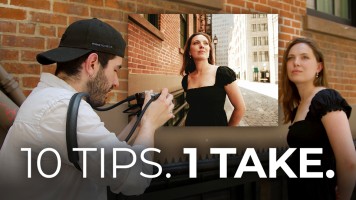
Natural light is a more affordable and accessible way to light your portraits, but it can be tough to master. Join Juan in this one-take video, as he shares his top 10 tips for mastering natural light and creating more compelling portrait photographs.
0:00 - Directional Lighting
1:13 - Hand Method
1:50 - Building Bounce
2:55 - Background Ideas
3:55 - Harsh Light
4:44 - Stop Posing Your Models
5:34 - Shoot in the Shade
6:20 - Catch Light
6:59 - The Last Tip

by John Harris · Posted
It would be foolish to claim that there is only one way to take a portrait, but there are some accepted norms and basic camera settings that you should understand if portraiture is to become your area of photographic interest. Remember though, as you walk down your creative path, that a portrait is more than a headshot, more than a beautiful photo of your subject; it is an opportunity to get to know someone, to have a visual conversation with a person, and to use your photographic skills to pass that understanding of the person on to the

Posted
“Live From New York, it’s Saturday Night!” That single sentence has become a catchphrase for devotees of comedy and popular culture for more than 50 years—generations of fans who willingly turn their attentions from the height of weekend revelry to the televised antics of Saturday Night Live.
Above Photograph © Mary Ellen Matthews
As this illustrious broadcast wraps its 51st season, we’re releasing an encore of our 2025 chat with SNL’s photographer-in-residence Mary Ellen Matthews, while we busy ourselves backstage to bring you some exciting

by Luke Rollins · Posted
Since its inception, the a7R series has been a mainstay of portrait photographers, for whom its high-resolution imagery benefitted large-scale prints in fashion, beauty, and art contexts. With the release of the a7R VI Mirrorless Camera, Sony has introduced speed into the portraitist's toolkit, eliminating the tradeoff between resolution and processing and making the act of portraiture one of agility and discovery.

by Mathew Malwitz · Posted
Who doesn’t want to capture fun and creative portraits of our four-legged friends? We know we love it. In fact, pet photography may just be the most popular form of photography there is. Think of all the smartphone snaps of yawns, big stretches, and funny moments we all take of our cats, dogs, chinchillas, and beyond.
Quick snaps aside, you know what really ups the quality of our pet portraits? Lighting. Just as with any form of portrait, lighting unlocks possibilities that can be impossible without it. But what lighting system should we use?

Posted
You can take portraits with what you have available, even if it's your smartphone and natural light. Composition, angles, and directing have a huge impact on the quality of your photo. However, if you're ready to invest in some gear, Juan shares his camera and lighting recommendations.
0:00 - In This Video
0:34 - Beginner Portrait Photography
4:19 - Mid-Level
8:12 - Professional Portraits 101
12:10 - Outro

by Luke Rollins · Posted
There comes a time in a photographer’s life—usually after some consistent success with an on-camera flash—when they say to themselves, "I’m ready to make my own light on demand." Thus begins a seemingly never-ending journey—first mastering the basics, then trying to put some feeling and expression into their photos.
Assuming you’re versed in

by Mathew Malwitz · Posted
We can say from experience that there’s nothing worse than your fingers freezing while on a winter photo shoot. From a scientific standpoint, exposure to the cold results in constriction of blood flow to the extremities, resulting in rapid temperature loss that approaches ambient temperatures. In layman’s terms, your hands get cold fast. Once you feel that chill, it’s nearly impossible to think about anything else.
Enter gloves. From mittens to liners, we all probably have more pairs of gloves than we know what to do with, but not all pairs

Posted
Paul Mobley and Ian Spanier have much in common: from starting their respective careers in New York City before relocating to the West Coast, to their knack for forging a human bond with portrait subjects, to an unrelenting drive to generate ambitious commercial assignments while being equally dedicated to complex personal projects.
Above Photograph © Ian Spanier
In today’s podcast, Paul and Ian compare notes on their photographic journeys from coast to coast, while discussing their shared inspiration for 20th century portrait masters such as

by Luke Rollins · Posted
Like a painter choosing a paintbrush, a photographer’s lens choice will dramatically affect the resulting picture. This is especially true when it comes to landscape photography. Lens choice can make a big difference when you don’t have the benefit of directing your subject. A mountain will not turn its face toward the sun, no matter how hard you beg. As a result, your creativity is limited to a couple of key factors, such as time of day, weather, and―you guessed it, lens choice.
Similar to the range of unique considerations to keep in mind

by Rebecca Melville · Posted
An on-camera flash is an indispensable accessory for many photographers. While it provides light to supplement dark conditions, an on-camera flash also allows you to achieve more balanced exposures in daylight conditions, permits freezing of fast-moving subjects, and can even be used to control other flash light sources. With so much to offer, an on-camera flash can become an integral part of your workflow, but where do you start? We are going to give you the on-camera flash rundown with everything you need to know to make the most of this

Posted
Photographer Marina Williams, known for her colorful and creative portraits, had the opportunity to test the Canon EOS R6 Mark III. Marina reflects on her creative journey and explains why the EOS R6 Mark III is a worthwhile upgrade for photographers.
0:00 - Intro
0:45 - About Marina
8:40 - Creative direction & styling
13:38 - Get variety & posing
16:03 - Marina's work today
18:39 - Upgrading to the Canon EOS R6 Mk III
20:39 -

by Todd Vorenkamp · Posted
Choosing a lens is a highly personal choice, and that’s especially true for wildlife photography. This is in the realm of the telephoto lens after all. While almost any focal length lens works for landscapes and other types of photography, in general, when it comes to photographing animals in the wild, you'll want to have the longest reach you can. In this guide, we’re going to discuss the factors one should consider when purchasing a lens for wildlife photography.
Focal Length
The first and most straightforward factor to consider is focal