Photography
- Recently Added
- Popularity
- Name
About 426 filtered results

by Allan Weitz · Posted
Skill and patience aside, if you want to capture successful photographs of babies and newborns, it helps to have a camera with features that enable you to capture what are more often than not fleeting, unrepeatable moments in time.
Attributes and features you should be looking for in a camera are quick autofocus and shutter-response times, wide-aperture optics for selective focusing, higher ISO sensitivities for low-light, flash-free imaging, high-speed continuous burst rates, multi-axis image stabilization, Silent Shooting modes, “Baby” scene

by Shawn C. Steiner · Posted
One of the biggest worries a photographer has during an extended trip is whether or not all of the digital files and photos they create will make it back with them. Everyone knows the best way to protect these precious documents and memories is to perform backups, just like you would if you were at home. However, there is the small problem that you aren’t at home with your RAID arrays and card readers and, in some cases, you may be stretching your devices’ batteries to the absolute limit. Here are some ways to make sure you are protected.
The

by Shawn C. Steiner · Posted
Thanks to the DSLR (and now mirrorless) revolution, video shooting has become extremely accessible to more and more individuals, especially the still photographer. Cameras today are emphasizing a combination of photography and video capabilities that produce images that are perfectly suitable for a gallery or movie theater. With many still photographers looking to dip their toes in the motion pool, we have put together the follow list of tools that can help greatly improve video quality.
Just starting out
First things first: if you are truly

by Shawn C. Steiner · Posted
If you ask anyone who the top camera manufacturers are today, I can guarantee Canon will be near or at the top of the list. The company’s products weren’t always top-of-the-line, but over the past decades Canon has built an impressive range of cameras that satisfy beginners and professionals alike. The sheer number of cameras and lines can be dizzying, though, so here is a helpful guide to help you figure out exactly which model is best for your needs.
The Professional’s Choices
When you want the best features, the most durable build quality,

by Allan Weitz · Posted
Architectural photography is both an art and an exacting craft. Unlike most genres of photography, in which level horizon lines and correction for keystone and parallax distortions are secondary issues, architectural photography requires a disciplined workflow and a keen sense of design.
The following eight items are tools I find extremely valuable for photographing the exteriors and interiors of homes and commercial buildings. This list is by no means complete, but it does cover a range of essentials. As for camera format, bigger is always

by Shawn C. Steiner · Posted
Two-sided debates have always consumed the photographic industry, be it film versus digital, primes versus zooms, or manual versus automatic. It is only fitting that the latest developments in camera design have spawned a new conversation: DSLR or mirrorless. Photographers old and new are asking the question, “Should I go mirrorless?” and, as we look forward to 2016, a definitive answer has only become more difficult to pin down. Right now there are some clear pros and cons to each system and, hopefully, after seeing the main points you will

by Richard Scali · Posted
As complementary as peanut butter is to jelly, the camera and tripod are an age-old pairing that still manages to maintain relevance and unmatched functionality in a world dominated by image stabilization and Photoshop tricks. While the form and function of a tripod is far simpler to understand than the scrolling menus of today’s feature-packed DSLRs, it can still be a chore to choose the right setup for your needs from among a sea of manufacturers and

by Bjorn Petersen · Posted
As cameras continue to evolve and impress, their newest features often play to the fast-paced multimedia world. For landscape photographers, the ability to minimize or eliminate the time it takes to print an image or display it online can have limited use, and tends to overshadow a range of core camera functions that appeal to our genre of photography. Landscape photography can arguably be one of the slowest-paced schools of image-making. As such, it does not have the same subset of requirements as many other categories of photography. Ranging

by Richard Scali · Posted
The word “photography” literally means “to draw with light” and is a simple way of expressing how essential light is to our craft. At times, however, natural light can be a scarce commodity and thus, it falls upon the photographer to create it. Fast-forwarding through the days of flash powder and disposable bulbs, we arrive at the modern day, an exciting time for “strobists,” when a plethora of compact options exists for creating and shaping light. Below, we’ll review some of the classic, essential, and innovative accessories for the

by Elizabeth Groeschen · Posted
Professional photographic gear and other electronic equipment are expensive and often equally delicate. But you already knew that. Handing off your gear to someone else—taxi drivers, airport baggage handlers, overnight couriers, and the like—the only thing safeguarding your gear is the case you use to transport it. If you have anything worth protecting, you should do it the way the pros do—with Pelican hard cases.
“Because the cases are waterproof and airtight, they can float—with a certain amount of weight inside.”
Even if you’ve never used
by Bjorn Petersen · Posted
As a photographer, it’s easy to get caught up with the quality of your gear. Are you outfitted with a high-resolution, full-frame sensor? How does the MTF curve of your lens compare to others? Can you record noise-free images at high-ISO levels? How many raw shots can your camera take before the buffer fills?
"Sometimes you just need a fresh shooting experience to allow you to home in on the creativity that photography can allow."
Getting the top-quality shots for clients is important, but obsessing over these details in your professional
by Daniel Wagner_1 · Posted
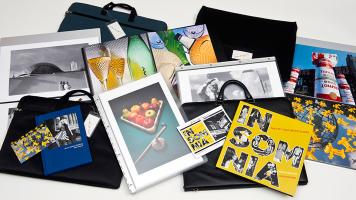
Whether you live to take photos, or take photos to earn a living, few things compare to the joy and satisfaction of making a new portfolio featuring your best shots. Besides being rewarding activities, marketing, meeting with buyers, and showing new work is essential to the success of a professional photographer. Slower periods such as those around holidays, the end of summer, and the first month of the year are ideal times to get your promotional materials in tiptop shape. Be sure to gather supplies ahead of time, as some portfolio materials

by Elizabeth Groeschen · Posted
For many photographers, carrying multiple lenses quickly becomes more of a requirement than an elective. And as most already know, with additional lenses come additional lens accessories and the inevitable question of which is worth the investment and space it will take up in your camera bag. While some accessories like caps and hoods often come in the box with a new lens, other protective gear like cases, wraps, and bands are typically sold separately. These protective items get lost quickly out in the field or in loose pockets, and are

by Daniel Wagner_1 · Posted
Always shooting with an on-camera flash is like always shooting with the sun behind your back. While this is a good way to illuminate a subject and capture an image, it may not be the best way to capture your imagination creatively. Positioning your flash off-camera, using an on-camera flash for fill with a second flash, or shooting with three or more Speedlites at the same time, is a great way to add a new level of expression and control to your photography. And, thanks to the integration of radio transmission on Canon’s latest Speedlites,

by Daniel Wagner_1 · Posted
What makes a Rolleiflex TLR so special? Many things. To start, TLR stands for twin lens reflex. “Twin” because there are two lenses. And reflex means that the photographer looks through the lens to view the reflected image of an object or scene on the focusing screen. Photographers also look through SLRs, or single lens reflex cameras. One of the differences between the two is that the SLR is held at eye level, and the TLR is held at chest level while the photographer looks through a “waist-level” finder. Another difference is that most SLRs